
Overview
The flag of the Autonomous Region of Madeira is the official flag associated with the Portuguese autonomous territory in the North Atlantic. In that setting, Madeira is not just the main island: the autonomous region covers the Madeira archipelago, which includes the islands of Madeira and Porto Santo, together with the Desertas and Selvagens groups. The regional capital is Funchal, on Madeira Island. That distinction matters because the name “Madeira” can refer to the main island, the wider archipelago, or, in political and administrative terms, the autonomous region itself.
As a territorial symbol, the flag has a clear official function. It is not a tourist, municipal, or private flag, but the emblem of the autonomous region. In institutional materials and public communications co-financed with regional public funds, the flag is used as part of the visual identity of the regional government and may appear alongside the Portuguese national flag and the European Union flag. The regional guide to information and publicity norms sets rules for its use, which shows that it is a formal and regulated symbol.
Design of the flag
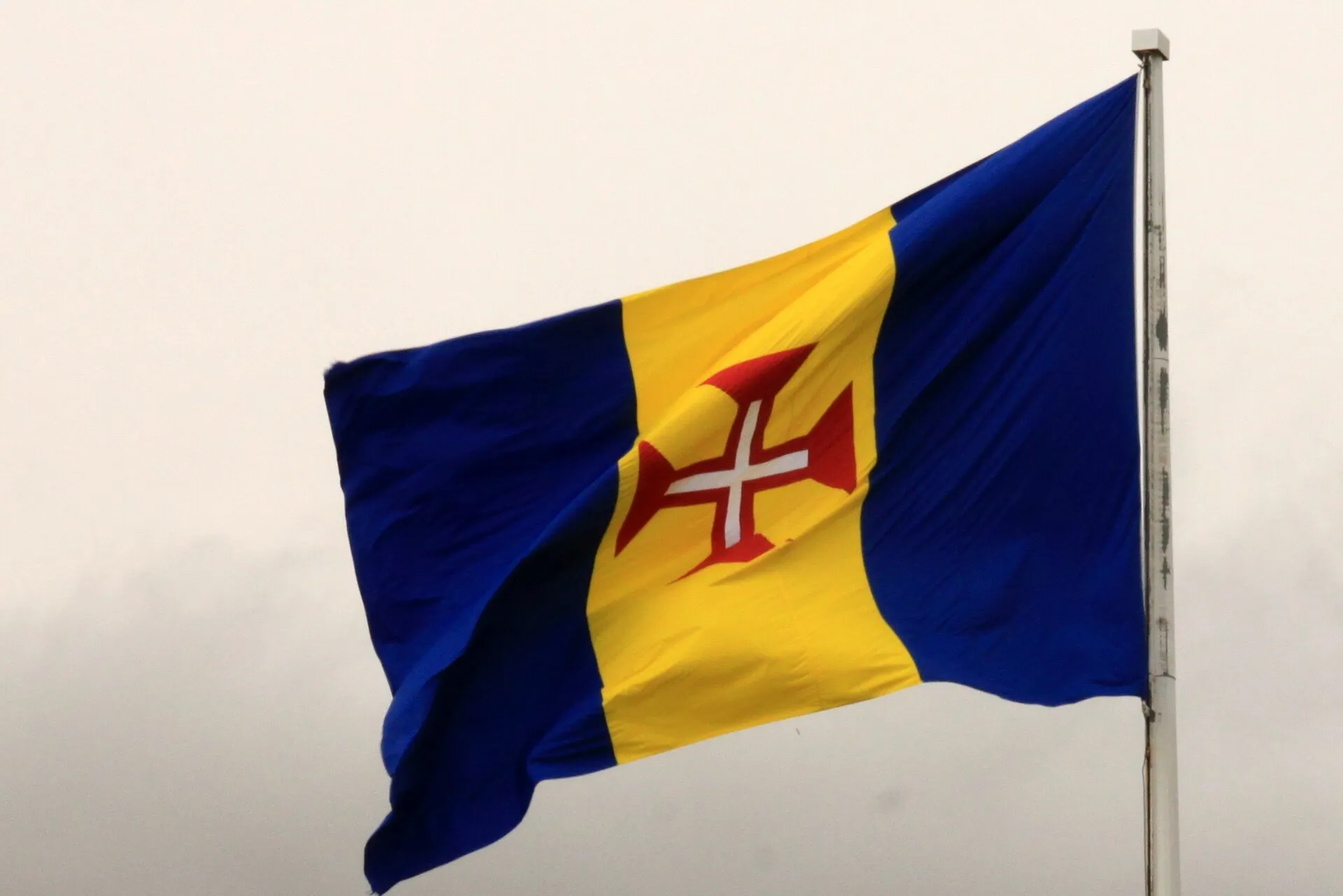
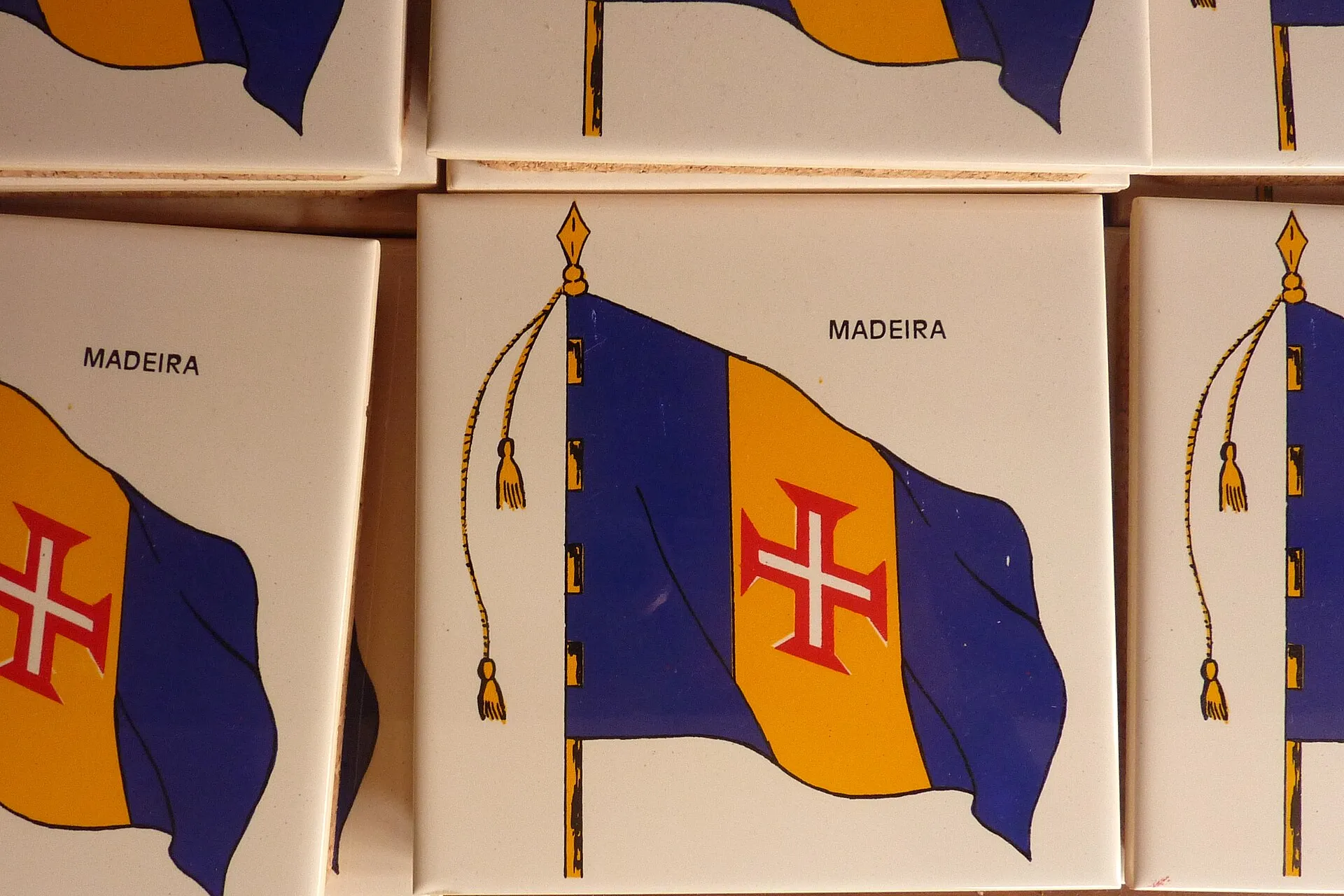
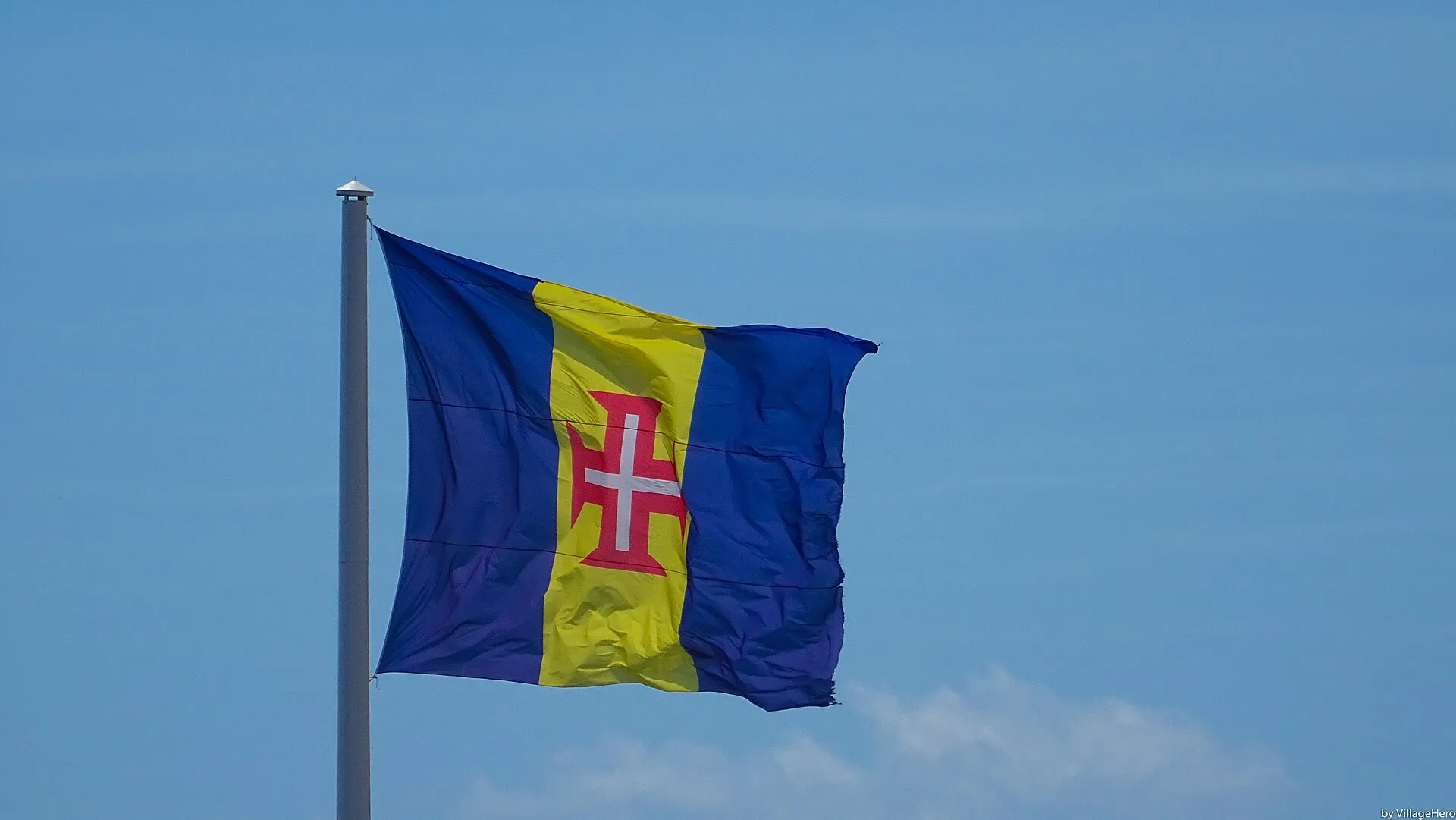
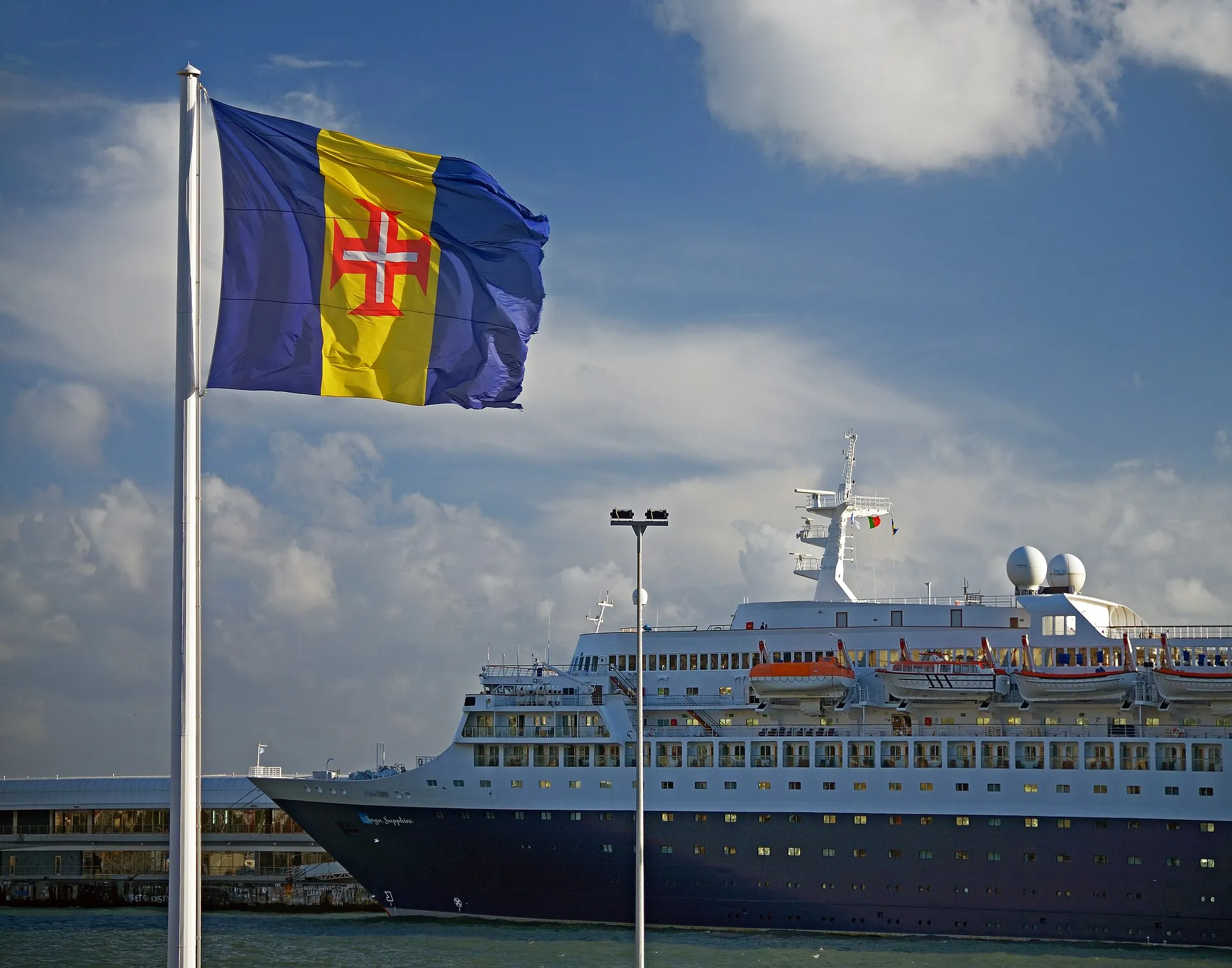
The design is straightforward but highly distinctive. The flag is vertically divided into three fields: blue at the edges and yellow in the centre. The Cross of the Order of Christ is placed over the central yellow field. The official regional guide consulted also describes the flag as rectangular, with a height equal to two-thirds of its width. That proportion helps give it a balanced appearance and makes it easy to reproduce across institutional formats.
Its visual clarity is one reason the flag is so easy to recognise. The contrast between the blue side bands and the yellow central band creates a composition that stands out at a distance, while the cross provides a strong central focus. Independent vexillological sources describe the same overall pattern and confirm that the region’s emblem uses this exact design: blue outer fields, yellow centre, and a cross in the middle.
The Cross of the Order of Christ
The most meaningful element of the flag is the Cross of the Order of Christ. In the Madeiran context, it evokes Portuguese history and the tradition linked to the settlement of the archipelago and maritime expansion. The vexillological description of the flag connects the cross with Portugal’s Atlantic heritage, while the regional guide includes it explicitly in the official design. Placed at the centre of the yellow field, it becomes both the visual anchor and the symbolic core of the flag.
This historical reading does not mean the flag is only a relic of the past. On the contrary, the cross acts as a bridge between contemporary regional autonomy and the historical memory of the archipelago within Portugal. The flag therefore communicates continuity, territorial belonging, and regional self-government at the same time. It is a modern official symbol that uses a heraldic language associated with long Portuguese historical traditions.
Institutional use and public communication
The regional guide to information and publicity is especially useful for understanding official use. In information and publicity materials co-financed by regional public spending, the flag of the Autonomous Region of Madeira must appear with the same prominence and at the same size as the European Union flag. The same document also states that the flag should be accompanied by the wording “Região Autónoma da Madeira.” This shows that the flag is not merely decorative: it functions as an institutional signature of the regional administration.
In public life, the flag appears in formal settings ranging from publications and institutional communications to ceremonies and official spaces. Independent vexillological sources note that the symbol is widely visible in Madeira and often appears together with the Portuguese national flag, especially on boats and in institutional settings. That observation is descriptive rather than prescriptive, but it helps explain how visibly the emblem is used across the territory.
Institutional use strengthens the flag’s role as an immediate marker of recognition. When it appears on a building, in a document, or in a public-communication format, its meaning is territorial and administrative: it represents the Autonomous Region of Madeira, not a business, a promotional campaign, or a specific municipality. That distinction matters because it avoids confusing the regional symbol with broader or unofficial uses of the name “Madeira.”
Madeira as archipelago and as autonomous region
Madeira is both a geographic and a political reality. Geographically, it is a volcanic archipelago in the North Atlantic belonging to Portugal, with two inhabited islands — Madeira and Porto Santo — and two uninhabited groups — the Desertas and the Selvagens. Politically, it is a Portuguese autonomous region. The flag belongs to that second dimension: it is the emblem of the autonomous administrative entity, even though the name “Madeira” is often used in everyday speech to refer to the main island or to the entire archipelago.
That dual meaning explains why the flag carries so much identity value. For residents and visitors, it stands for the territory as a whole; for public administration, it identifies a regional government structure; and for Portuguese cultural history, it links the island and archipelago to a wider tradition of maritime symbols. The flag therefore sits at the intersection of geography, autonomy, and historical memory.
How to read the flag today
If the goal is simply to recognise Madeira’s flag, the essential visual formula is easy to remember: blue, yellow, blue, with the Cross of the Order of Christ in the middle. That combination distinguishes it from other Portuguese regional flags and from many island flags in Europe. The design is simple, but its meaning is anchored in its official status as a symbol of Madeiran autonomy.
In contemporary public language, the flag of Madeira expresses a central idea: that an Atlantic Portuguese region can have its own identity and institutions while remaining part of the Portuguese state. The symbol is therefore both local and national, historical and administrative. That combination explains its strong presence in official materials and its immediate recognisability among people who know the archipelago.
Final reading
The flag of the Autonomous Region of Madeira is more than a graphic mark. Its concentrated design — blue bands, a yellow field, and the Cross of the Order of Christ — expresses political autonomy, Atlantic belonging, and the historical heritage of the archipelago. Official norms confirm its institutional status, while vexillological descriptions help explain its visibility and symbolic reading. Together, these elements make the flag one of the most durable and recognisable icons of contemporary Madeira.